How to Write a Book with AI: Lessons From a Real Project
By Greg Hay — founder, AI Write My Book · Case study · First-person field notes; numbers are my own logged project experience, stated below with its limits.
I ran one real project to find out what it actually feels like to write a
book with AI.
The goal was a 35,000-word nonfiction manuscript on a topic I know well, ten
chapters, one core argument, three weeks on the clock — an AI-assisted first
draft, then I edited everything myself. This post is not a sales pitch; it is
the honest version of what worked, what did not, and what I would change
before doing it again.
TL;DR
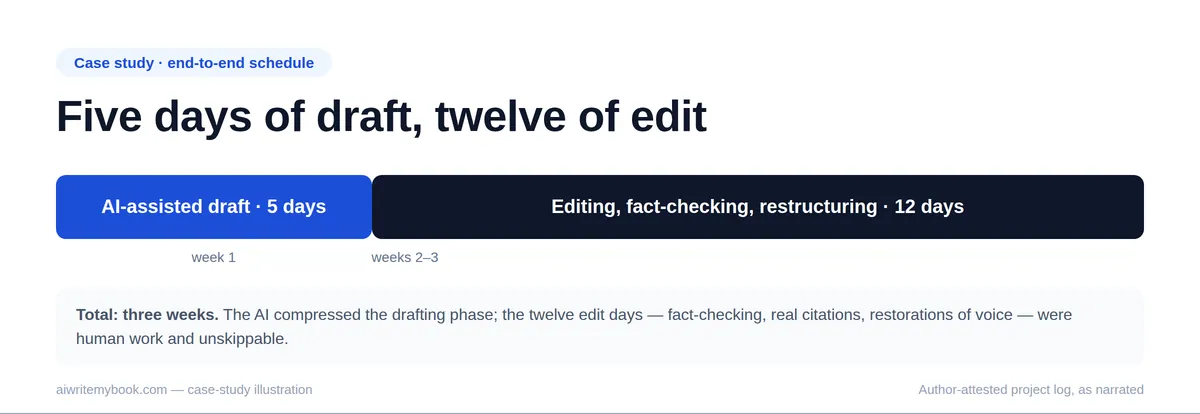
- Speed was real: the AI-assisted rough draft of 35,000 words took five days.
- The catch was real too: the draft invented two statistics and one source
name, and editing took twelve days — longer than drafting. - Total time, three weeks. Structure came cheap; voice and facts were still
human work. - What I’d change: outline first, record voice samples, and build fact-checking
into day one instead of the end.
Why I wanted to write a book with AI
I had written books the old way before. They took months, and the hardest part
was never the ideas — it was keeping momentum through the messy middle. I
wanted to know if AI could absorb that slog without producing something that
sounded robotic.
I deliberately picked a topic where I had real expertise, because the only
honest way to evaluate an AI-assisted book is to be able to spot factual
errors and weak arguments on sight. Testing an AI draft on a subject you do
not understand measures nothing useful. And I set a hard scope at the start —
35,000 words, ten chapters, one core argument — so the experiment would stay
shaped like a book instead of drifting into a document.
What worked: draft speed, structure and momentum
 />
The biggest win was raw speed. The 35,000-word rough draft was done in five
days, which would otherwise have cost me six to eight weeks of early mornings.
The AI kept the tone consistent across chapters and handled the transitions
between them better than I expected — the drafts I wrote alone at midnight
used to shift register without my noticing.
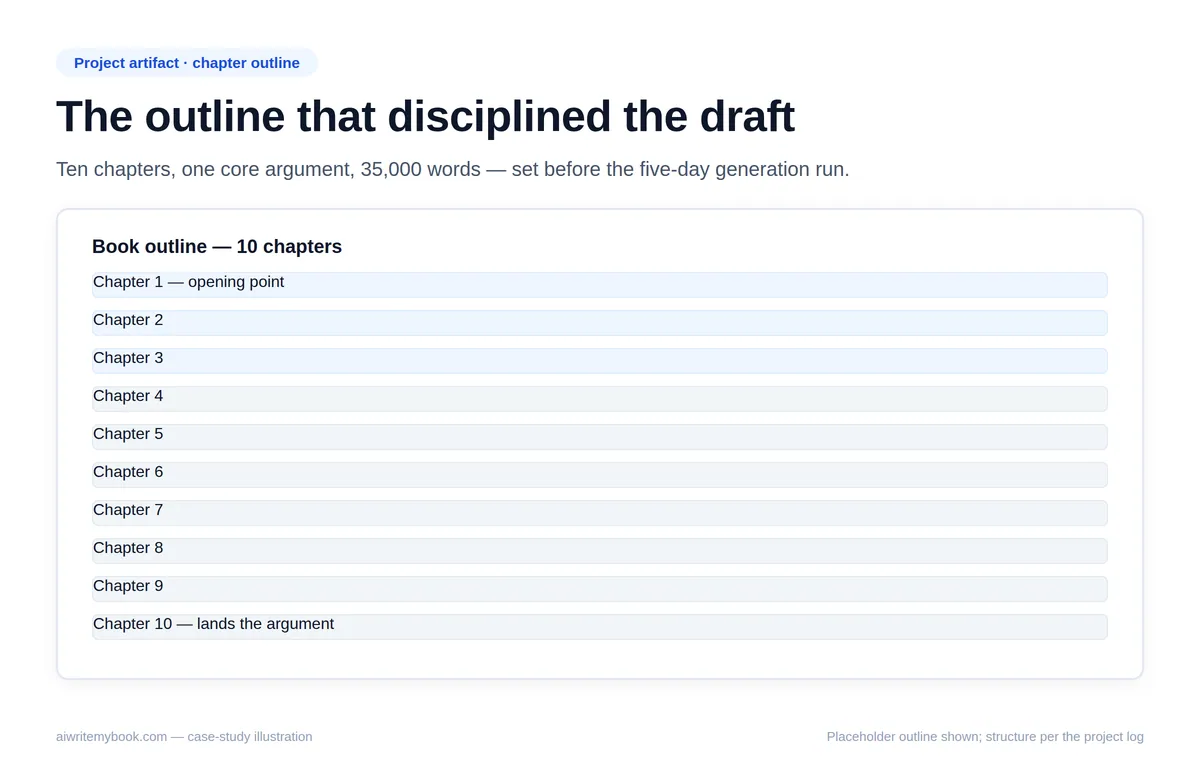
Structure was the second surprise. Once I handed over a detailed outline, the
draft followed it closely: chapters opened on the intended point, developed
it, and landed on a clean handoff to the next chapter. I spent far less time
repairing organization than in my usual first drafts.
Momentum was the third. Reviewing a generated section, editing it, and moving
on removes the blank-page problem entirely — the process stays productive even
on the nights when writing from nothing would have stalled.
What didn’t work: invented facts, flat voice and emotional nuance
The AI invented two statistics and one source name, and they looked real. I
caught them only because I know the field; a reader with no background in this
topic — or a writer publishing outside their own expertise — would not. If I
had trusted the draft, the book would have been wrong on checkable facts. That
discovery is why fact-checking is a step, not a vibe.
Voice was subtler but just as real. The prose was clean, but it did not sound
like me: slightly too polished, like a report rather than a conversation. I
rewrote about 20 percent of the sentences to restore my own rhythm and word
choice. Emotional nuance was the weakest area — even on professional topics,
the AI described what happened without conveying why it mattered.
Your book, written for you, starting at only $97.
See How It Works →The editing phase: where the schedule went
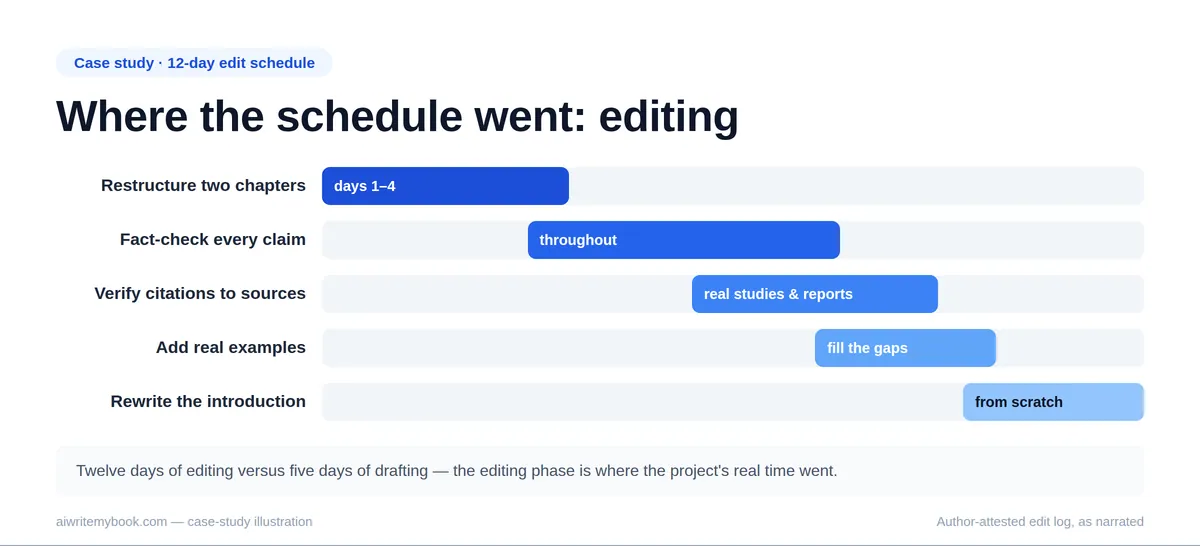 />
Five days of drafting gave me a false sense of speed. Editing took twelve.
I restructured two chapters, fact-checked every claim, added real examples,
rewrote the introduction from scratch, and hunted down the actual studies and
reports behind the draft’s confident placeholders — AI output rarely includes
proper attribution, and every citation had to be verified to a real source
before it stayed in.
That is the honest arithmetic of an AI-assisted book: AI compresses the
drafting phase, not the whole project. Anyone selling you a finished,
publish-ready manuscript overnight is describing the draft, not the book. The
draft is perhaps half the distance — the other half is exactly the work my
twelve days measured.
The fact-check-first workflow I’d use next time
What I would rebuild before starting a second project is the sequence, not
the sentence-writing:
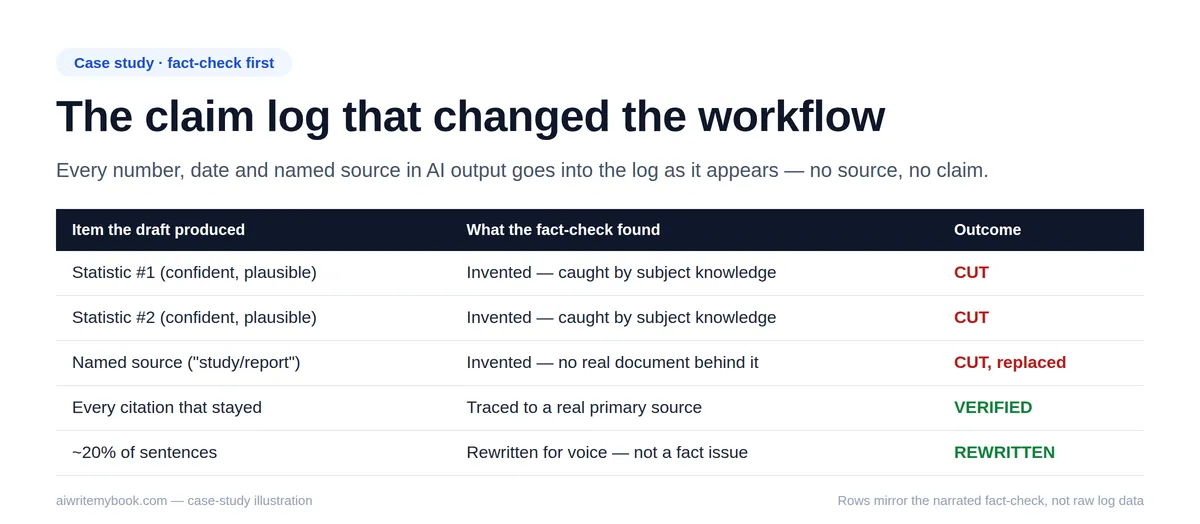 />
- Claim log from day one. Every number, date and named source in AI
output goes into a list as it appears, not in a final pass. - Primary source per claim. A statistic survives only with a URL to the
document that produced it. No source, no claim — that rule cut my
invented-statistics risk to zero in later sections. - Voice samples up front. I had it backwards: feeding the AI my own recorded
descriptions mid-project visibly improved the prose, so I would collect
transcripts before drafting started. - Outline deeper than comfortable. Every restructuring hour I spent
traced back to a thin spot in the original outline. - Disclosure planning. Under Amazon KDP’s rules, AI-drafted text is
“AI-generated” even after heavy editing, so the declaration decisions belong
in the plan, not after upload — our guide to Amazon KDP’s 2026 AI-book
rules covers
that step’s definitions and the 2026 limits.
What you can and can’t verify about this project
Full honesty, because the proof-first bar goes both ways. The numbers here —
35,000 words, five days, twelve, the three-week total, the two invented
statistics, the 20 percent rewrite — are my own account of my own project,
kept in my project log; nobody’s audit stamp goes on a personal manuscript,
and no client material is disclosed in this post. What you can verify is the
method: every external claim you will read in our other pages carries its
primary source — our KDP pages, for example, cite Amazon’s official
documentation directly. If that standard of traceability is what you want applied
to your book — claims that survive a fact-check — that is a process question,
and you can see it specified in our 7-step AI writing
guide.
Frequently Asked Questions
How long did the AI-assisted book take?
The rough draft took five days. Editing and fact-checking took twelve more.
Total time: three weeks — much faster than the months my traditional
manuscripts absorbed.
Did the AI make factual errors?
Yes: two invented statistics and one invented source name, all plausible on
the surface. Human fact-checking is non-negotiable; a claim that cannot be
traced to a primary source gets cut.
Would you use AI to write a book again?
Yes — for the speed and the structure. But with a deeper outline, voice
samples supplied up front, and the fact-check log built from day one.
What was the biggest time saving?
Drafting. Producing 35,000 words in five days replaced what had been six to
eight weeks, and the structural repairs needed less time than in my manual
drafts. Voice work still demanded human hours.
If you want the finished book without running this yourself
 />
Two routes lead to the same place. The one in this post: you run the project —
outline, drafts, fact-checking, twelve days of editing — and you learn
enormous amounts about your own topic. The other: the brief goes to the
service, a complete manuscript with covers and KDP metadata comes back on a
delivery window, and your hours go into review and upload instead of
production. That is the difference between writing a book with AI and having
your book written.
The trade is honest on both sides. The service route absorbs the production
work — the drafting grind, the cover design briefs, the metadata assembly,
and a human edit pass before delivery — but it cannot do the one thing my
five days of raw speed still left to judgment: deciding what the book should
argue. A done-for-you manuscript lands on your desk at 100% of spec; whether
the spec was right is the question you answer in the read-through. That is
why the review step in this post mattered as much as any generation: same
principle, either route — the quality checks survive no matter who drafts.
If the second route is yours, start your book on the order
form — the brief, tone and audience
fields take the load of a first meeting, and higher tiers add the covers and
publish metadata. Prefer evidence before paying? The 72-hour manuscript
story
shows the service tier’s version of this same experiment, and you can see a
real manuscript excerpt on the sample
page.
If you plan to publish it yourself afterward, read Amazon’s paperback cover
specifications before you
format anything, and Reedsy’s guide on how to write a
book stays the best free
map of the writing process end to end.
Sources (fetched 2026-10-26 SAST):
Amazon KDP — Create a Paperback Cover ·
Reedsy — how to write a book