
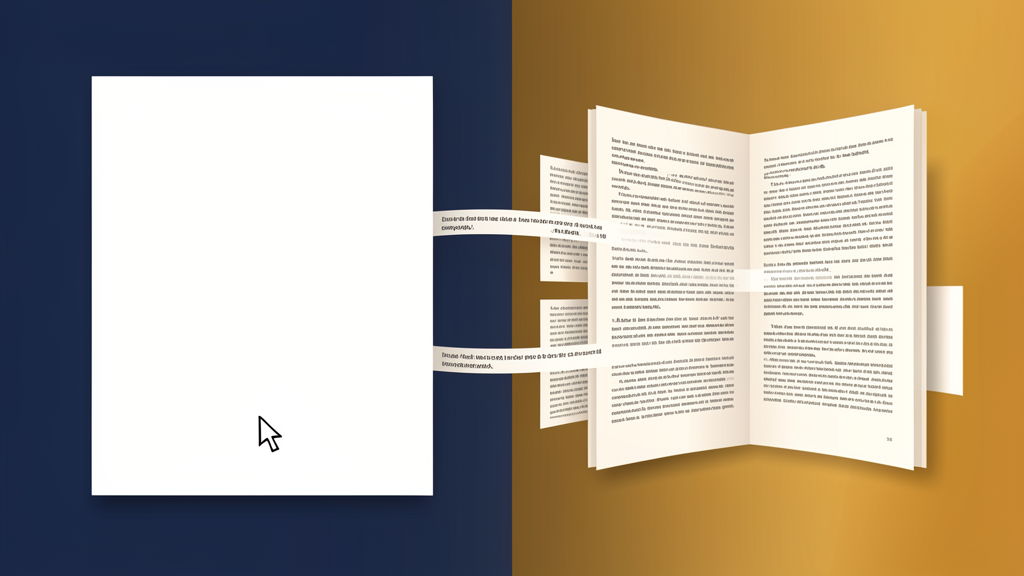
Every author, from aspiring novelists to seasoned professionals, eventually faces the daunting blank page. Writer’s block can derail projects for months or even years. Traditionally, authors might hire a ghostwriter or abandon their manuscript entirely. Today, AI offers a third path: a collaborative tool that breaks through creative paralysis without replacing the author’s voice.
What writer’s block actually is
Writer’s block is not a single thing. It shows up differently depending on who you ask. For some it is the inability to start. They have ideas but cannot get the first sentence down. For others it is the mid-manuscript wall, where the story stalls around chapter seven and every paragraph feels like dragging concrete. For executives and professionals, it is usually time pressure married to perfectionism. They know what they want to say but cannot find the hours to say it well.
The cost is not just emotional. A book that sits unfinished for two years is a book that is not generating royalties, building authority, or opening speaking opportunities. The longer it sits, the harder it gets to return to. For a faster path, compare the cost to write a book with AI against the months of stalled progress.
Why AI works where willpower fails
The problem with most writer’s block advice is that it assumes the block is motivational. Just sit down and write, people say. Set a timer. Turn off your phone. But most authors who are stuck are not lazy. They are overwhelmed by the gap between what is in their head and what appears on the page.
AI bridges that gap. You give it your rough thoughts, your bullet points, your voice notes, and it produces a draft. Not a perfect draft. A starting point. Something to react to, edit, and shape. For most blocked authors, having something on the page is 80% of the battle. Editing is easier than creating from nothing.
How to use AI to break through
The process is not complicated, but it does require honesty about what you want.
Start with what you have. If you have an outline, feed it to the AI. If you have nothing but a title and a vague idea, tell it that. The AI works with whatever you give it. The more specific your input, the closer the output will be to what you want.
Ask for a rough draft, not a finished chapter. The goal is momentum, not perfection. Tell the AI to write a rough version of chapter one based on your outline. It will produce something. That something might be 70% wrong, but the 30% that works gives you a foundation to build on.
Edit aggressively. The AI does not know your voice. It does not know your audience. It will produce competent prose that sounds like nobody in particular. Your job is to make it sound like you. Cut the generic phrases, add your specific examples, and rewrite anything that feels like it came from a template.
Keep going. Once chapter one is drafted, move to chapter two. Do not polish chapter one to death before moving on. Get the whole manuscript drafted first, then revise. This is the same advice every writing teacher gives, and AI makes it easier to follow because the drafting phase is no longer agonising.
Your book, written for you, starting at only $97.
See How It Works →What AI cannot do
AI will not give you a story worth telling. It will not provide the insight that makes a business book valuable, or the emotional truth that makes a novel resonate. Those come from you. What AI does is handle the mechanics of turning your ideas into prose, so you can focus on the substance.
If your book is boring, AI will make it boring faster. If your ideas are thin, AI will not thicken them. It is a tool for overcoming the friction of writing, not a substitute for having something to say.
The cost of waiting
Most authors who contact us have been thinking about their book for between two and five years. Some have been thinking about it for over a decade. In that time, they have not written a single chapter. They have not published. They have not built the authority that a published book creates. They have spent that time feeling guilty about not writing.
AI book writing services exist because that guilt is real and the cost of waiting is measurable. If you have a book inside you and writer’s block is the wall between you and a finished manuscript, AI is the ladder. You still have to climb it.
FAQ: AI and writer’s block
Is using AI to write a book cheating?
No. You provide the ideas, the direction, and the final edit. AI handles the drafting mechanics. Think of it like a typewriter that can also suggest sentences. The book is still yours.
Will the book sound like me or like a robot?
That depends on how you edit. The AI draft is a starting point. If you do not revise it, it will sound generic. If you rewrite passages in your own voice and add your own examples, it will sound like you.
How long does it take to get a draft?
With an AI book writing service, you can have a full manuscript draft in days, not months. The editing and revision phase still takes time, but the wall of starting from nothing is gone.
What if I have no outline, just an idea?
That is fine. The service helps you build an outline from your idea before drafting. Many authors start with nothing more than a paragraph of description.
Copyright and Ownership
Once your draft is ready, confirm you understand your AI-written book copyright before publishing.
Ready to start?
If you have been stuck on your book for months or years, start your book with AI. You will get a draft based on your ideas, written in a style you can shape and own. The first chapter could exist by next week. The question is whether you want to spend another year thinking about it.
Related Articles
If you are stuck, a best AI book writing services may be the fastest way to finish your manuscript.
Compare the investment to months of stalled progress by reviewing the cost to write a book with AI.
New to AI-assisted writing? Start with our breakdown of can AI really write a full book.
Authors who treat AI as a creative partner often finish faster — here is why smart authors use AI.